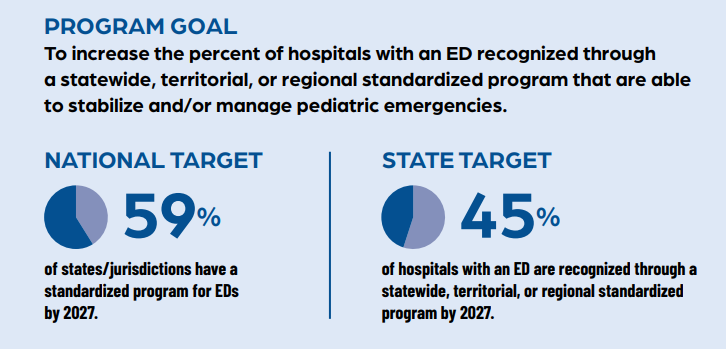
To meet this performance measure, the Federal EMSC Program has standardized program requirements, which are:
- Establish a multidisciplinary team to oversee the program. Members could include individuals from your EMSC Advisory Council; applicable state health department divisions or bureaus, licensing, or medical boards; or national organizations/professional societies and their state chapters or regional contacts.
- Include, at a minimum (in any tier/level), the following criteria:
- A designated nurse and physician PECC,
- Weigh pediatric patients in kilograms only,
- Record pediatric patients’ weights in kilograms only, and
- A disaster plan that addresses the needs of children.
- Create a verification process to validate that the facility meets program requirements. The process must include a facility site review, which may be inperson and/or virtual.
- At least one hospital ED must be formally recognized.
Work with your HRSA Project Officer to ensure your supporting documents have been reviewed before starting the pilot phase.
Established standardized programs should:
- Work on increasing the number of EDs formally recognized by the program.
- Track all hospital EDs that are recognized by their corresponding category, recognition, or designation level.
- Update CLMS annually to reflect each hospital formally recognized (the EDC will provide the Federal EMSC Program with the updated CLMS).
- Aim to achieve annual targets (page 22).
- Seek guidance from the support team to explore strategies on how to incorporate the new elements (see Figure 1 on page 27).
Note: This performance measure does not require that the standardized program to be mandated; voluntary recognition is accepted.
Phase 0 - No Progress
- Review the action plan recommendations on page 25 of the State Partnership Implementation Manual for suggested starting points and steps to begin developing a recognition program.
Phase 1 - Research and Planning: Explore existing guidance and national resources to help establish program goals, identify criteria, and plan your recognition program.
- Pediatric Readiness Recognition Program Criteria Considerations: Considerations for developing recognition criteria for hospitals.
- National Pediatric Readiness Project (NPRP): Use NPRP findings and resources to inform program planning and identify opportunities to improve Pediatric Readiness.
- Emergency Departments, Pediatric Readiness, and EMSC Hospital Recognition Fact Sheet: Learn more about the connection between Pediatric Readiness and hospital recognition programs.
Phase 2 - Development: Use these resources to guide program design, establish requirements, and develop the materials and processes needed for implementation.
- Implementation Resources: Review suggested strategies and considerations for implementing a Pediatric Readiness Recognition Program.
- Implementation Checklist: Use this checklist to organize and track key implementation activities.
Phase 3 - Process: Coordinate with HRSA to share program information and confirm that technical assistance (TA) resources have been submitted. This step helps ensure the appropriate communication and coordination are in place as the program moves forward.
Phase 4 - Pilot: Begin testing program processes and preparing for broader implementation.
- View current ED and EMS Recognition Programs: Explore the map of existing programs to see how other states are approaching recognition.
- Recognition Program Verification Discussion: Watch the PRRP 2026 Cohort discussion on verifying program requirements, processes, and criteria before moving toward formal recognition.
Phase 5 - Formal Recognition: Move toward formalizing and launching the recognition program. Establish the processes for recognizing participating hospitals or EMS agencies, communicating recognition, and maintaining the program over time.
Additional Resources:
- PRRP Exchange: Register for the PRRP Exchange to connect with other state programs, share experiences, and discuss questions and implementation strategies.
- State-Created Resource Library: Explore resources by state to find tools, examples, and materials developed by other state EMSC programs.