
Prehospital Pediatric Readiness
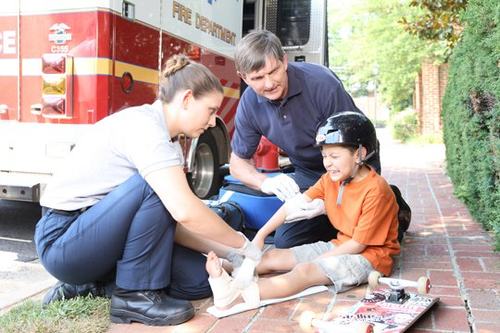
Pediatric Readiness is defined as ensuring that every EMS agency has the champions, competencies, policies, equipment, and other resources needed to provide high-quality emergency care for children.An assessment used to evaluate pediatric readiness in the prehospital space is the Prehospital Pediatric Readiness Project (PPRP) assessment which launched nationwide in 2024. The PPRP assessment is a 100-point scale that examines eight different domains of pediatric readiness:
- Education and competency for providers
- Equipment and supplies
- Interactions with systems of care
- Coordination of pediatric emergency care
- Patient and family centered care
- Patient and medical safety
- Policies, procedures, and protocols
- Quality and performance improvement
In the emergency department high readiness scores are associated with lower short- and long-term mortality risk in pediatrics. A similar result is presumed in the prehospital space although data collection and research are ongoing.To get started exploring pediatric readiness:
- Review the Technical Report
- Review the Policy Statement
- Review the Readiness Checklist
- Take the PPRP Assessment
- Once gaps are identified explore the Prehospital Readiness Toolkit
- Engage with your leadership to establish buy-in and support
- Reach out to the NH EMSC Program Manager maria.c.varanka@hitchcock.org
What is a PECC?
PECCs are the pediatric champion for their service and are tasked with advocating for pediatrics at the local level. Responsibilities include familiarizing colleagues with pediatric-specific policies and protocols, promoting pediatric quality improvement efforts, managing pediatric equipment and supplies, and being the local point of contact for the states EMSC Program Manager.
Having PECCs in the ED is tied to double-digit increases in Pediatric Readiness scores (which are measured on a scale of 0-100). Since significant survival benefits exist at 88 points or above, a PECC is one of the strongest drivers of improved pediatric outcomes. While prehospital research is ongoing, it is expected that PECCs in EMS agencies will have a similar impact.
The following organizations recommend the assignment of a PECC:
- American Academy of Pediatrics
- American College of Emergency Physicians
- American College of Surgeons
- Emergency Nurses Association
- Emergency Medical Services for Children
- National Association of State EMS Officials
- National EMS Advisory Committee
- National Academy of Sciences
Who can be a PECC?
One or two licensed EMS providers of any level can serve in the PECC role. This role may also serve multiple locations. Some suggestions of how this might look in different services includes:
- One licensed provider who assumes the PECC role and responsibilities for their service
- One ALS PECC and one BLS PECC
- One dayshift PECC and one nightshift PECC
- Two PECCs who split multiple locations. For example, PECC A is responsible for two stations and PECC B is responsible for three stations.
PECCs do not need to have any specialized pediatric training or certifications to assume the role although ideally over time they seek out pediatric education for themselves and their service.
The person in the PECC role ideally still provides patient care on a semi regular basis. While this role is primarily administrative type work, it’s important that the PECC maintains a “boots on the ground” perspective.
Ideally, PECCs should have a specific job description, recognition, and support from administration.
How to establish a PECC
- Resources to support PECC work can be found here.
- Contact the NH EMSC Program Manager maria.c.varanka@hitchcock.org
- Obtain buy-in from service leadership
- State of NH Ambulance Equipment Inspection Form - Last updated 2024
- Joint Position Statement Recommended Essential Equipment for BLS & ALS Ground Ambulances - Last updated 2020
Commonly noted discrepancies:
- Infant head cover (may not be included in your OB kit -check your kit for a list of contents)
- Material or device intended to maintain body temperature
- Tools that provided pre calculated weight-based dosing
- If using a length based tape check for recalls
- Pediatric specific restraint system [see section below]
- Chest Decompression needles:
- 14g diameter, maximum length 1.5 inches (3.8 cm) for patients less than 56 inches (144 cm) long
- 23g diameter, maximum length 0.75 inches (2cm) for newborn
Child Passenger Safety (CPS) for EMS is a complex subject from both a provider and administrative perspective. There are no federal or industry consensus standards in the United States for devices used to secure children in ambulances. The following highlights the current information available to make the emergency transport of children as safe as possible.
- NHTSA Working Group Best-Practice Recommendations for the Safe Transportation of Children in Emergency Ground Ambulances (2012)
- NASEMSO Safe Transport of Children by EMS: Interim Guidance (2025)
- NH EMS Protocol Pediatric Transport 8.12
Additionally, work is being done at the federal level to address this regulatory gap. Publicly available updates to that project will be posted below.
Items to consider when purchasing a CPS device:
- Per NH State Protocol CPS devices must be five points
- Per NH State Protocol any child who fits on a length based resuscitation tape must be secured to the stretcher using a CPS device
- The CPS device must fit the stretcher per manufacturer instructions
- There are several different applications used to secure the CPS device to the stretcher and secure the CPS device to the patient (Velcro, snaps, buckles, etc.). In the absence of CPS testing standards consider which application may offer the safest method to secure a pediatric patient.
Testing Child Passenger Safety Devices for Ambulances
The NASEMSO Safe Transport of Children (STC) Committee began a multiyear project to develop, validate, and publish child restraint crash test methods. The first phase was to draft crash test methodology intended to evaluate the safety of commercially available devices used to secure children in the back of an ambulance. Test methods were drafted for three unique transport situations:
- supine pediatric patients;
- seated pediatric patients or child passengers; and
- supine neonatal patients.
Phase I was completed in June 2024. Phase II, crash testing of pediatric restraint devices currently available in the U.S. market, has just recently begun. More information and updates to this project can be found here.